
Background
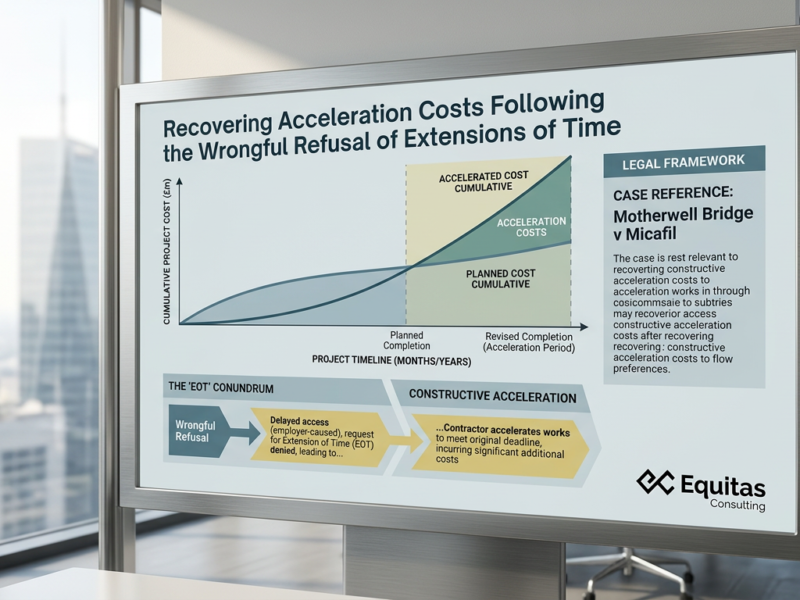
In the complex landscape of construction law, the recovery of costs associated with accelerating works remains a frequent point of contention. While many standard forms, such as the FIDIC, JCT, and NEC suites, contain express provisions for instructed acceleration, the situation becomes more nuanced when a contractor accelerates unilaterally to mitigate the impact of employer-caused delays. The decision of the Technology and Construction Court (TCC) in Motherwell Bridge Construction Ltd v Micafil [2002] serves as a seminal authority on this issue, particularly regarding the entitlement to costs when an Extension of Time (EOT) is withheld.
The dispute arose from two sub-contracts based on FIDIC principles for the construction of an autoclave. During the project, the defendant, Micafil, introduced significant design modifications that the claimant, Motherwell Bridge Storage Tanks (MBST), contended were far beyond the original scope of works. These changes resulted in substantial delays to the progress of the works.
Key Issues
As completion dates loomed, MBST sought an EOT to account for the delays caused by the design changes. However, Micafil refused to grant the requested relief and maintained that the original contractual completion dates were still in effect. Faced with the threat of Liquidated Damages (LADs) and the commercial pressure to meet the deadline, MBST implemented acceleration measures, including intensive night-shift operations, to recover the lost time.
The central question for the court was whether a contractor could recover the additional expenditure incurred through acceleration in the absence of a formal instruction from the employer. MBST argued that because the delays were critical and employer-caused, the refusal to grant an EOT constituted a breach of contract, making the acceleration costs recoverable as damages.
Decision
The court adopted a rigorous two-stage forensic delay analysis to determine entitlement. First, the tribunal examined whether the delays in question were truly on the critical path. Second, it sought to identify if the contractor was responsible for any portion of that delay. Upon reviewing the evidence, the court found that the delays were indeed critical and were not attributable to MBST.
Following the principles established in Henry Boot Construction (UK) Ltd v Malmaison Hotel (Manchester) Ltd, the court held that MBST was entitled to an EOT and, consequently, prolongation costs. Crucially, the court also found in favour of the claimant regarding acceleration. It ruled that MBST was entitled to recover the additional costs of the accelerated working as damages for Micafil’s breach of contract in failing to grant the EOT. This position was recently reinforced in the Australian case of V601 Developments Pty Ltd v Probuild Constructions Pty Ltd [2021], suggesting a consistent international judicial trend.
Analysis
The decision is analytically significant because it addresses the concept often referred to as “constructive acceleration.” In many jurisdictions, most notably the United States, constructive acceleration is a recognised doctrine where a contractor is forced to accelerate due to an unjustified refusal of an EOT. Under English law, however, the term is less formalised because standard contracts usually require a written instruction for acceleration to be compensable.
The TCC’s approach in Motherwell Bridge bypasses the need for a specific “acceleration clause” by framing the recovery as damages for a breach of the obligation to properly administer the contract. When a contract administrator or employer wrongly refuses an EOT, they effectively compel the contractor to choose between late delivery (and the subsequent risk of LADs) or incurring additional costs to finish on time. The court viewed the costs of the latter as a direct and foreseeable consequence of the employer’s failure to award the time relief to which the contractor was entitled.
Practical Implications
For practitioners and delay experts, this ruling highlights several critical takeaways:
1. Documentation and Notice: Contractors must ensure that their delay notifications and EOT claims are substantiated with robust contemporaneous records. The ability to recover acceleration costs as damages depends entirely on proving that the underlying delay was critical and that the EOT was validly due but withheld.
2. Delay Analysis Methodology: The court’s reliance on established delay analysis principles underscores the importance of using recognised techniques, such as Time Impact Analysis (TIA) or impacted as-planned methodologies, to demonstrate the effect of employer risks on the completion date.
3. Employer Risks: Employers and contract administrators should be wary of using the refusal of an EOT as a tactical tool. If a tribunal later determines that the EOT was wrongfully withheld, the employer may be liable not only for the contractor’s prolongation costs but also for the significantly higher costs associated with intensive acceleration measures.
4. Mitigation vs. Voluntary Action: There is a fine line between a contractor’s general duty to mitigate delay and an acceleration effort that warrants compensation. Practitioners must clearly distinguish between measures taken to recover contractor-caused culpable delay and those taken to overcome employer-caused events in the face of a denied EOT.
If you are managing a project where extensions of time have been disputed or where acceleration has become necessary to meet contractual milestones, Equitas Consulting can provide expert forensic delay and quantum support to protect your position. We invite you to contact our team to discuss how these legal principles apply to your specific circumstances.