
The International Chamber of Commerce has published its 2025 Dispute Resolution Statistics. Beneath the headline numbers lies a clear message for the construction sector — and a particularly relevant one for parties operating between Türkiye and a London arbitral seat.
Construction remains the engine of international arbitration
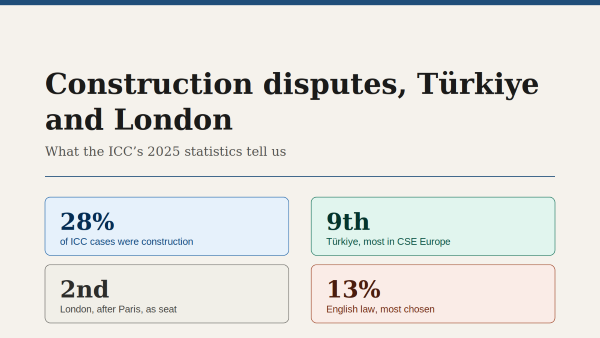
Year after year, the construction and engineering sector generates more ICC arbitrations than any other field, and 2025 was no exception. The sector accounted for 246 cases — 28% of all new filings registered with the ICC Court during the year. Add the closely related energy sector, which contributed a further 15%, and these two infrastructure-heavy fields together represent 43% of everything the ICC took on in 2025.
The pattern holds when the data is viewed by contract type rather than sector. Construction and engineering contracts were the most frequent type behind new arbitrations, at 21.5% of filings, ahead of contracts for goods, services and corporate transactions. For an industry built on complex, long-duration, multi-party contracts, this concentration is no accident: construction projects carry inherent exposure to delay, variation, disruption and payment disputes, and when those disputes cannot be resolved on site, international arbitration remains the forum of choice.
Türkiye’s continuing prominence
For parties in our region, the 2025 figures confirm a trend we see in our own practice. Turkish parties were involved in 60 ICC cases, making Türkiye the ninth most represented nationality worldwide and the single most represented nationality within Central and South-East Europe.
This visibility reflects the reality of Turkish industry. Turkish contractors and employers are among the most active internationally, delivering major infrastructure, transport, power and process projects across the Middle East, Africa, Central Asia and beyond. Many of these projects are governed by FIDIC forms of contract and provide for ICC arbitration, so it is unsurprising that Turkish parties feature so consistently in the ICC’s caseload. Türkiye also appeared among the governing laws chosen by parties and among the jurisdictions selected as the place of arbitration, underlining the country’s growing footprint in international dispute resolution.
London and English law: an enduring combination
If Türkiye supplies a significant share of the parties, London continues to supply a significant share of the forum. The United Kingdom was the second most frequently selected jurisdiction for the place of arbitration, with 78 cases, and London ranked as the second most chosen city in the world, behind only Paris.
English law, meanwhile, was once again the most frequently selected governing law, applied in 113 cases — around 13% of all new filings. For cross-border construction disputes in particular, the combination of a London seat and English governing law remains a default that many parties reach for, valued for the predictability of English contract law, the supportiveness of the English courts towards arbitration, and the depth of expertise available in the London market.
The wider picture
Several further figures are worth noting for those drafting and managing construction contracts. The average amount in dispute in new cases was just over US$50 million, but the median was US$5 million — a reminder that the ICC’s caseload is not confined to mega-projects, and that mid-value disputes make up the bulk of the work. Proceedings that concluded by final award in 2025 took, on average, 27 months, with a median of 23 months.
Overall, the ICC registered 894 new cases during the year and closed it with a record 1,869 cases pending — clear evidence that demand for institutional arbitration shows no sign of slowing. For anyone negotiating a construction contract, the lesson is consistent: the dispute resolution clause is not boilerplate. The choice of seat, governing law and administering institution shapes everything that follows if a dispute arises, and those choices are best made deliberately, by reference to real and observable patterns rather than habit alone.
How Equitas Consulting can help
This is precisely the space in which Equitas Consulting works. Based in London, we have extensive experience in international arbitrations involving Turkish parties and operate equally in English and Turkish. We combine FIDIC contract expertise, forensic delay and quantum analysis and expert evidence with the ability to work seamlessly across both jurisdictions — so that nothing is lost in translation, whether technical or legal.
If your project sits between Türkiye and a London seat, or anywhere along the international construction value chain, we would be glad to discuss how we can support you in avoiding, managing and resolving disputes.
Source: ICC Dispute Resolution 2025 Statistics, International Chamber of Commerce.